Wednesday, January 2, 2019

Film Recommendation: Hereditary

Since Hereditary has finally arrived on Amazon Prime, I thought it would be great to recommend not only one of the best films of 2018, but also, one of the best horror films in a long time.

Toni Colletta stars as Annie Graham, an artist who is coping with the tragic and sudden death of her mother as she is finishing her diorama of her family for an art project. Alex Wolf plays Peter, Colletta's son, in the film and Gabriel Bryne plays Colletta's father. All the characters are coping and facing with not only the tragic death of a family member but also with the numerous other events that plague the family.


Horror films have always been a staple to my love of films. No other genera can make me experience so many emotions throughout its runtime. Horror films can make you feel uneasy, tense, anxious, sad, and even at times hopeful. It is a genre ripe with possibilities and so many ways to take the audience on an emotional rollercoaster. However, great horror film has been in a decline lately. This genre has been plagued with cheap jump scares, cliches, and bad stories. However, Hereditary comes into the masses to show not only to show what a true horror film is like, but to also scare the crap out of everyone.


One of the ways that Hereditary is able to make the audience scared is through its cinematography. Director Ari Aster and cinematographer Pawel Pogorzelski chose to shoot the film with a lot of long takes. Aster does not use quick editing or quick cuts to add horror; rather, he utilizes long takes to put the audience in a sort of frightening spell; putting them in an uneasy state when they are forced to stare at the horrific. There will be many long scenes with no cuts and at the start of the scene, you might see something right at the corner of the camera. As soon as you notice it, it will quickly disappear out of frame; yet, the camera still continues to move with the characters and linger on. As the camera is moving with or away from the characters, you sit and wonder, what did I just see? You start to peer at the corner of the frame to see if something will pop out or creep back into frame. Sometimes, something will come and it will scare you; other times, the scene will continue, gripping you in the unknown. It is the anticipation and the fear of what could be beyond what we are seeing that makes nearly the entirety of the film an anxious rollercoaster.

But outside of the horror element, the long takes let us sit with the characters and sit with their emotions. One scene in particular, which I will not spoil, where Toni Colletta's character is begging her husband to do something for her; rather than creating tension and emotion through quick cuts between the two characters, it is filmed in just one long take. By filming it in a long take, it makes you watch Colletta cry and beg her husband to help her in this nearly unimaginable situation she is in. It was such a hard, emotional, scene to watch, yet, Aster and Pogorzelski want us to dwell in the difficulty of watching the scene. They don't want to give us any breathing room to allow us to take a break; they want us to feel what the characters are feeling at all times.

However, cinematography can be great and all, but if the story and the characters are bad, then good visuals won't matter. Luckily, the story and the characters in this film are on the same level as the masterful cinematography. Without spoiling anything, the film goes into so many directions, with so many twists and turns, that it leaves you on the edge of your seat for most of its runtime. What really makes this film unique, is the aspect of the story of dealing with grief. This is not some typical horror film, where some paranormal activity haunts a family. Hereditary is a film with the themes of facing grief, and how we deal with tragic events in our lives. These themes and story beats are illuminated with all of the fascinating and layered characters of the film. These characters have to deal with events that we could never imagine facing, and the way their characters react to these events is just so fascinating.


These characters are boosted up by the top-notch performances from (nearly) everyone. Toni Colletta deserves an Oscar nomination for her role. The number of emotions she needs to portray and the amount of trauma that she is inflicted with, and how she is able to capture all of that through her acting is pretty remarkable. Colletta shows so many emotions just through her facial expressions alone. The way she uses her eyes, by enlargening them and by how she focuses and moves them during an argument, or when she is terrified, is such remarkable detail added to her character. Nearly everyone else in the film did a remarkable job as well. But, much credit needs to be given to Toni Colletta because every scene she was in, she clearly stole the show.


Past all the technical and story aspects of the film, Hereditary, is a horror film, so we need to talk about the actual horror element of it, and man is it scary. This is what real horror is like. There are no jump scares, or something running right in front of the camera to scream at you, not any of that cliche garbage. Rather the horror in Hereditary is portrayed through the depression and fear of the characters. After a series of tragic event, we see the slow destruction of a family. We see how they are all slowly becoming mentally fatigued and terrified; and how that then plays out with their interactions with their family. Seeing this slow descent of the family is terrifying for so many reasons.
It is portraying a regular, every-day, family losing and destroying themselves. It is something that, while many of us might not think about it, could happen to our own family as well. It is a reliable, an "at home," horror film. But, it is the way the film portrays this slow descent amongst the characters that really make it horrific. You see the characters getting mad at one another for irrational reasons; you witness the characters mentally hurting themselves and not being able to take the event surrounding them. This close connection with the family, and the destruction of this family, is one of the scariest things I've seen in a theatre in a long time.

However, it cannot be a horror film without some weird scary things happening, and this film has plenty of that as well. As mentioned before, sometimes, you will see something in the corner of the frame that quickly disappears. It makes you anxious wondering what it was and when will it appear again. As the film progresses, the film slowly becomes scarier as you get more information about the family. Not to spoil anything, because you really want to go into this blindly but you will really be caught off guard by many of the events and sequences in this film. The film goes from family drama to psychological horror, to even more bizarre horror, and all of these types of horrors add up to an anxiety-inducing horror film. Every act of this film has a different type of horror to offer you, and when the film gets to the really spooky, creepy stuff, it really hits it hard.

However, as almost anything you love, there are some aspects of this film that are not as amazing. Granted, these are nitpicking, but even the negatives of a film I love should be mentioned. For one, I said almost everyone did a phenomenal job in the film. While this is true, I did have mixed feelings on Alex Wolf's performance of Toni Colletta's son, Peter. At times, he did a phenomenal job. One scene in particular (if you've seen the film, you know which one) where the camera just holds on him and just seeing his facial expression really shows that he is a great actor. But sometimes, I did feel he was a bit uneven in his performance. Sometimes his character's persona would change and the way Wolf portrayed that was not as good as it could have been. Another small issue is pacing. Some segments in the middle did take a while to go through, and while I do get why it was done that way, I do feel like it could have been cut just slightly. Lastly, I feel that in the end, the film did too much talking to explaining what is happening. Really, leaving some ambiguity would have worked wonders. While there was ambiguity, the last couple of minutes does somewhat spell out the conclusion to the film for you.

Overall, Hereditary is a phenomenal horror film. It works as a drama about a family dealing with a tragic event, but also as a pure psychological horror film. This and The Witch (also on Amazon Prime) are some of the best horror films in recent memory. If you haven't seen it, please go do so. If you have seen it once, watch it again because seeing it a second time, there are so many scenes and elements of foreshadowing at the start of the film that you might not have gotten in your first viewing. Overall, a phenomenal horror film and an instant classic I highly recommend you all to check out Hereditary since I believe, in due time, it will become a classic

Score: 9/10

Monday, December 31, 2018

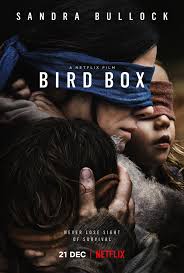
Bird Box Review

Netflix's new film is a bland, Cliche ridden, and unsuspenseful film that commits one of the biggest crimes a film can commit: being boring


Bird Box's premise is an interesting one. Some plague or monster is devastating the earth and if you see it, you kill yourself. It is a very interesting premise that has a lot of grounds to be exciting and suspenseful. And at first, I thought it would be like that. Seeing how Sandra Bullock's character tells her kids to keep the blindfolds no matter what happens or what they hear, and if they take them off they could die; it all seems pretty interesting. However, things slowly start to fall apart.

For starters, one awful aspect of the films is the editing and the pacing. Just the first 20-30 min of this film shows the entirety of how poorly edited and paced this film was. The movie starts with Bullock telling her kids to cover their eyes with the blindfolds. After that, the film goes into one of its many flashback sequences. Bullock is seen with her sister, and they have a very brief conversation. During this conversation, the characters mention how there is this plague in Russia making people go crazy. Not much thought or attention is put into that, so they leave to go to the hospital to check up on Bullock's baby. Minutes later, in the hospital after checking up on Bullock's character's baby, they see a girl banging her head on a glass window killing herself. A couple of seconds later, Sandra Bullock mentions, after not really paying attention to the news story about this plague in Russia, declares that the plague has arrived in America. A couple of seconds later, an explosion happens and then Bullock's sister kills herself due to the plague. All of this happens in the first 12 minutes of the film. If you thought this paragraph was annoying to read, with so many things happening one after the other, that's because this was the first 12 minutes of this film. We never get attached to Bullock's sister, things happen so quickly you have no idea what is going on, and all these crazy events happening in the span of 12 minutes lets nothing marinate to the audience. Instead of taking its time to set anything up, such as in other great apocalyptic films like Children of Men, they just get to the point with no weight attached to anything that is going on.


What makes the editing worse is that this film is one of the most visually bland and uncreative films in a long time. It is by no means visually bad, but it is so painfully average. No great visuals, no creative use of colors or placement of objects and characters--nothing. In a film where the characters need to cover their eyes from the monster, you would think there would be a lot of creative shots and sequences to showcase the characters fear; maybe trying to keep us in the dark along with the characters themselves. Maybe making the film visually claustrophobic, showcasing how the characters probably feel that way with the blindfolds on. Well, that is what a good creative film would do. This, however, is not one of those types of films.

One sequence in particular, where the characters have to drive to a store to get some supplies, had such great set up for a visually scary and tense scene; yet, the film lets that down. They cover the windows of the car and only use the GPS in order to not see the thing that is causing everyone to kill themselves. So, how do they film this sequence? Do they solely focus the camera inside the car, trying to pull us in with how the characters are feeling? Nope. This scene is shot in the same style as when Bullock's sister drove away from the hospital. Just shots outside of the car, some shots inside, sweeping shots when they pass through something, and some reaction shots. Why? Why are these two totally different scenes with totally different purposes in emotions and style, shot the exact same way? This is just lazy and bland visual storytelling.

These, however, would not be as big of a problem if we had some good characters to latch on too. Yet, we don't have any good characters in this film. Every character we meet have nothing interesting about them; they are essentially cliches. We have the one asshole character, who opposes giving aid to anyone. We have the super nice strong guy, who is always willing to lend a hand and willing to have the forced romance with the main female character with. We have the weird hippy guy who writes novels about the end of the world and how he theorized this will happen. These are cliches that we have seen in nearly every other bad film in the past. We get maybe one scene where we hear one story about these character's lives prior to this outbreak, and that is about it. Even if they were cliches, if the writers gave us a decent backstory to these characters, then at least we could be somewhat attached to them. However, not only do these characters not have any interesting personality or backstory, but they are all cliches. They did the bare minimum when it came to characters.

They also did the bare minimum in terms of giving us an overall theme of the film. Maybe I did not pay attention that much, but I really did not see an overall theme put throughout the film. Some say it could be about the difficulties of motherhood...but I did not see that at all. Without providing a good theme, the monsters in the film seem pointless. What is the point of a monster making people kill themselves if there is no relation to an overall theme or to a specific character's plight? Imagine, for instance, if in The Babadook, the monster in that film did not represent depression. It would make the film a lot more boring and less entertaining. In that film, the monster representing depression relates to the overall theme of the main character's depression and her battling to combat her depression. Bird Box, however, doesn't do any of that. The monsters are just monsters, every event happens and there is no big theme attached to any action or character in this film.

Overall, This film is such a disappointment. Not because I had any hopes or expectations when going into the film, but rather, because seeing what Netflix could and have done in terms of original content lately, and seeing this cliche-ridden film get so much attention just baffles me. When you have films like Roma, a film telling a personal story about a family, a film that gets you emotionally invested in the characters plights and hardships; or films like Annihilation, a film that talks about humanity and biology and is one of the most visual and haunting films in a long time, seeing Bird Box get so much attention is just disappointing. Bird Box has nothing going for it. Sure, Bullock is decent and there are like 3 decently shot scenes, but this is a film that is just so forgettable and boring. Skip this one

Score: 2/10

Saturday, December 29, 2018

Black Mirror Bandersnatch Review

A creative Gimmick that, while fun, does not help mitigate the bland and empty story.


Netflix's new Black Mirror episode, Bandersnatch, is an interesting one. It is a choose-your-own-adventure episode about someone reading a choose-your-own-adventure novel, who then wants to make a choose-your-own-adventure video game, who then feels like he is not in control of his own actions. This episode could have been a mess, it could have failed in so many ways. It could have had little differences in any of the multiple endings, it could have had choices that do not affect the story in meaningful ways, and it could have just been a test demo for Netflix's future projects. However, while this is by no means an amazing episode, mostly due to a bland story and some of the aspects of choosing the choices not being as exciting, the gimmick of making decisions for the character in the episode can be really fun, especially when you're doing it with other people.

The story is somewhat basic at first. The protagonist, Stefan Butler, loves this book called the Bandersnatch; a choose-your-own-adventure novel. In loving this book so much, he uses his computer skills to make a video game based off of that novel. Then, the lines between reality and game seem to blur, as the character starts to lose control over his actions, as we the viewer start to take control of his actions.

The decision making aspect of this story is pretty easy to follow and comprehend. You have a ten-second timer and two decisions to make. You choose whichever one you want and then you are taken wherever the story takes you. Pretty simple stuff that Netflix de-briefs you right before starting the episode itself to get you ready for how to play. The episode's decisions start out simple. For example, the first decision you make, a seemingly pointless one at first, is choosing which cereal to eat for breakfast. As time passes however, the decisions will become grander and more relevant to which ending you get. Won't spoil anything here, but there are some interesting, outlandish and funny (in the Black Mirror dark humor sort of way) choices you make throughout the story. Every choice you make does matter in how the story progresses, and it can lead to some interesting and crazy outcomes.

The crazy story narratives are aided by great performances and visuals. Everyone, even the side characters your barely get to know or see, play their roles with such great dedication and enjoyment. With the different branching narratives, some of the characters personalities and personas change drastically throughout, and they all seem to mesh well with one another. All the acting was believable and everyone seemed to have fun in their roles.


In terms of visuals, Black Mirror has always boasted some really visually stunning episodes. San Junerpino and Nosedive being some of the highlights for me in terms of visuals. Bandersnatch, while not as good as those two previous episodes mentioned in terms of visuals, does have some pretty good visuals. There are some good long takes at times, some good use of CGI, and good use of colors that help add depth to each scene. Nothing amazing, but having good visuals for some Television Shows is something that should be mentioned.

Yeah, it is a pretty fun episode; however, while I have been praising it, there really is nothing that special once you get past the choose-your-own-adventure aspect. The story itself is pretty forgettable. Not a whole lot happens at first, and while it does go off the wall in some ways, it was just a very meh story. Nothing awful, nothing amazing. As with every Black Mirror episode, there is a theme or a commentary about technology and society that runs throughout the entire episode. In this episode, the theme is clearly about free-will. I say clearly because it is extremely on the nose. The occasional talk about free-will and determinism can be pretty hilarious. This episode is very self-referential, with characters asking questions like "why am I not in control of my actions?" to some characters having monologues about the idea of free-will and predestination. I chuckled a couple of times knowing that the writers knew that they should not take themselves too seriously. However, while it was funny, past being funny there was nothing else added with the themes. You will not have a discussion about whether or not humans have free will or what free will actually means. While that is fine, not every episode needs to have that a deep philosophical argument at the end, at times the talking and the monologues about free will can get a bit annoying. Once the joke wears off, there is really nothing else of substance when it comes to these discussions in the story.

However, outside of the bland story elements, some of the choosing elements of this episode is pretty mixed. Sometimes, based on what you choose, the episode will tell you to choose where you want to go back in terms of re-doing some of the choices you made. It's basically having someone telling "yeah you messed up so go fix it." That's fine, and maybe I just made dumb decisions, but to be repeatedly forced to do that was a bit annoying. It could have just kept going with whatever decision I made and either have that as an ending or, have more story parts to continue based on that decision. Sure, that might take forever to do, but it is still an annoyance.

In terms of the multiple endings, I got nearly all of them replaying some of the decisions over again and seeing where they would lead me. The novelty of choosing your decision does wear off after a while, and once it does, the overall package does as well. At a point, you really will not care about how the story ends. Sure, you will want to complete it to get all the endings, but that is pretty much it. It was more of an obligation for me to check off all the endings, rather than me being totally invested and wanting to find out where the different decisions will take me.

Overall, this was a fun episode. It was nothing amazing, but the element of choosing how the story plays out gives so much possibility for Netflix and other streaming channels to experiment more with telling a story. Now, I hope that this does not happen to every show out there; I do not want Fargo season 4 to have a choose-your-own-adventure episode. But, I feel that for some shows, episodic shows like Black Mirror, it can work decently. While there were other Netflix shows that have done this before, such as Netflix's Puss in Book: Trapped in an Epic Tale, none have gone this far into creating such a fun experience and a showcase of what can be done. That is exactly what this episode was; a fun experience being a showcase for what can be done for the future. Past that, however, in terms of story and even in terms of how far this could be taken, there really is nothing amazing about this episode. But it was very fun and something I will probably go back into with some friends or family just to see the different endings and choices.

Score: 7/10

Black Mirror: Rachel, Jack and Ashley Too

Good idea, that ends up being a total mess Well, what a bummer. Ever since I saw the trailer for this episode, I was pretty excited. M...